
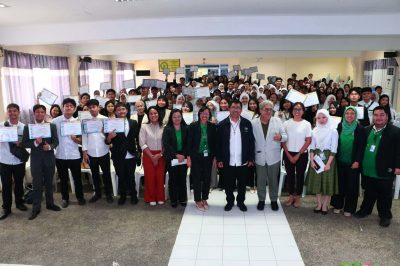
Notre Dame University (NDU) put the spotlight on student-led research during the 11th University Research Festival held on March 13, 2026, at Tanghalang Michael Clark, Nepomuceno Building as Senior High School researchers presented 15 rigorous and socially relevant studies. Anchored on the theme “Advancing Knowledge through Oblate Transformative Research, Sharing in the Oblate Mission,” the festival showcased the research competence, social awareness, and creative inquiry of NDU – SHS students, affirming the institution’s commitment to nurturing the next generation of transformative thinkers.
The event gathered students across strands—Science, Technology, Engineering, and Mathematics (STEM), Humanities and Social Sciences (HUMSS), and Accountancy, Business, and Management (ABM)—who presented studies that address pressing societal, environmental, and technological issues with academic depth and innovation.
STEM Contributions: Health, Environment, Technology, and Conservation
STEM student-researchers showcased innovations and evidence-based analyses that respond to health concerns, environmental sustainability, and science learning.
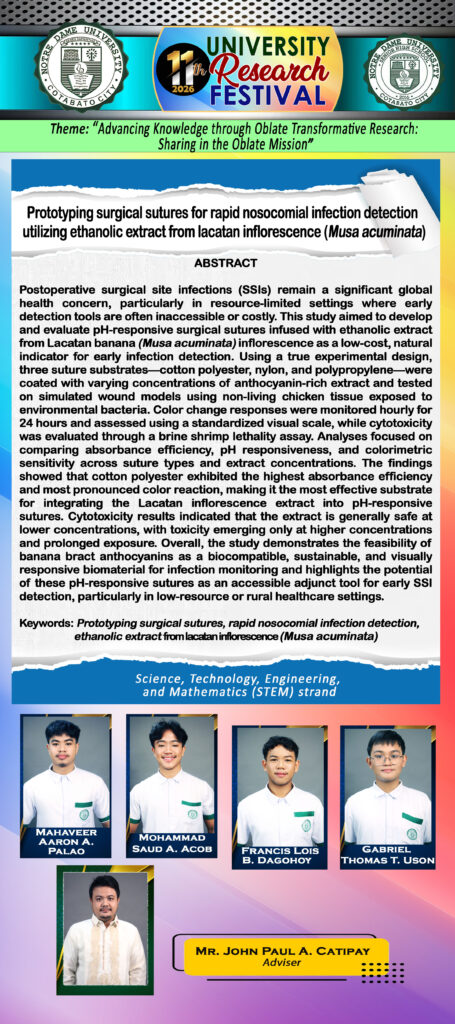
Prototyping surgical sutures for rapid nosocomial infection detection utilizing ethanolic extract from lacatan inflorescence (Musa acuminata)
Mahaveer Aaron A. Palao, Mohammad Saud A. Acob, Francis Lois B. Dagohoy, and Gabriel Thomas T. Uson developed pH-responsive sutures coated with anthocyanin-rich ethanolic extract from Lacatan banana inflorescence. Testing on simulated wounds showed that cotton polyester sutures had the best absorbance and color change, demonstrating the feasibility of a low-cost, biocompatible visual indicator for early infection detection in low-resource settings.
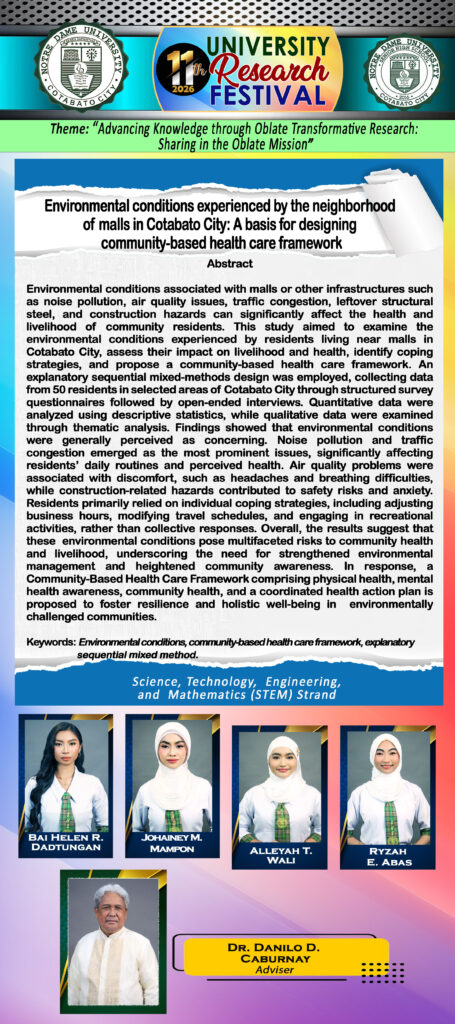
Environmental conditions experienced by the neighborhood of malls in Cotabato City: A basis for designing community-based health care framework
Bai Helen R. Dadtungan, Johainey M. Mampon, Alleyah T. Wali, and Ryzah E. Abas documented the environmental impacts of malls—including noise, traffic, air quality, and construction hazards—on nearby residents in Cotabato City. Their study led to a Community-Based Health Care Framework that integrates physical health, mental health, and coordinated community action.
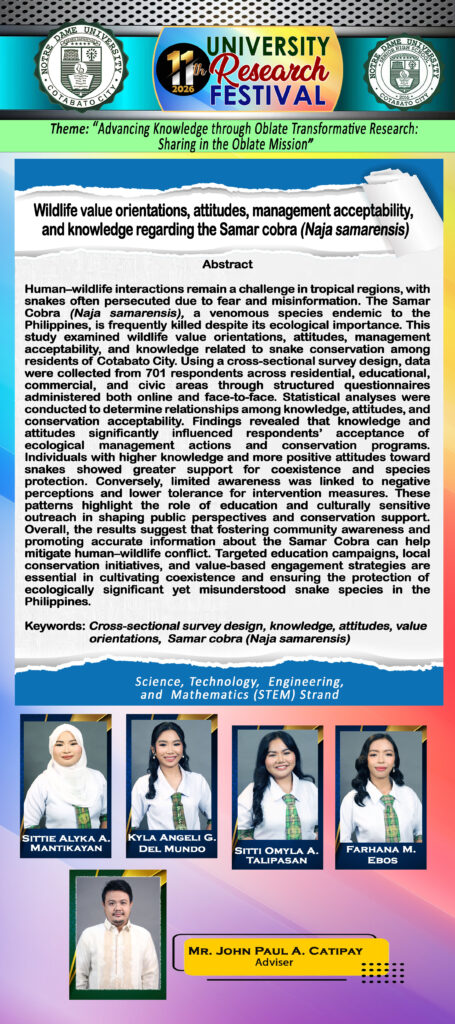
Wildlife value orientations, attitudes, management acceptability, and knowledge regarding the Samar cobra (Naja samarensis)
Sittie Alyka A. Mantikayan, Kyla Angeli G. Del Mundo, Sitti Omyla A. Talipasan, and Farhana M. Ebos surveyed 701 residents on their knowledge, attitudes, and management acceptability regarding the Samar Cobra (Naja samarensis). They found that higher knowledge and more positive attitudes were linked to greater support for conservation, underscoring the importance of education and culturally sensitive outreach to reduce snake persecution.
Project ‘Alaf Halāl: Testing the genome–food permissibility in a select chicken feed toward permissible poultry nutrition
Saifullah T. Panalangin, Kevin Cyrus A. Balustre, John Lloyd P. Cantre, and Nurhassan U. Abdul assessed the awareness of halal feed standards among Muslim and non-Muslim feed sellers and validated product permissibility using real-time PCR. While Muslim respondents showed higher awareness, laboratory analysis detected porcine DNA in a tested feed sample, highlighting the need for stricter monitoring and verification of poultry feeds.
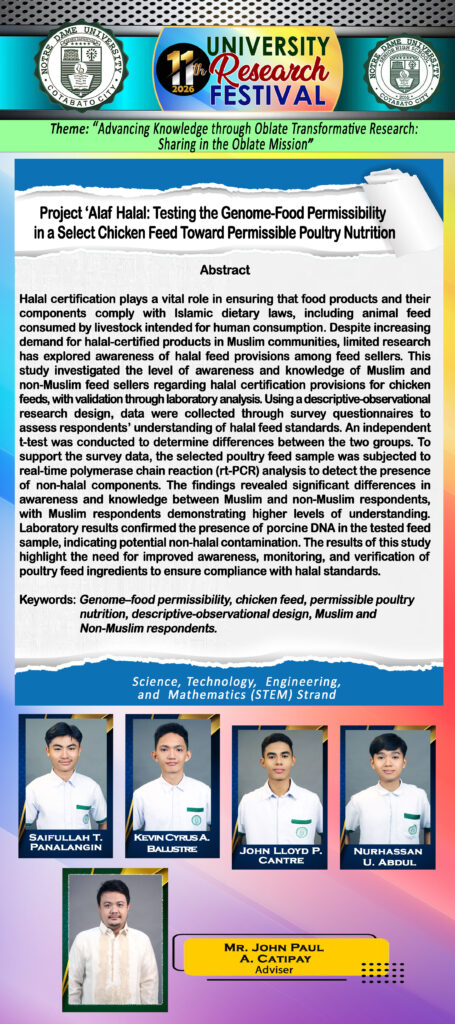
Development and gamification of Impylse in Roblox: A physics-based educational game on kinematics and dynamics
Prince Nasrullah A. Tungkay, Naif Ymer Yousef S. Cusain, Mangawasa E. Mipantao III, and Heart S. Abdulatip designed Impylse, a Roblox-based educational game on kinematics and dynamics for non-STEM SHS students. Using a one-group pretest–posttest design, they recorded significant gains in understanding Newtonian mechanics and high engagement ratings, demonstrating the promise of gamified learning in physics.
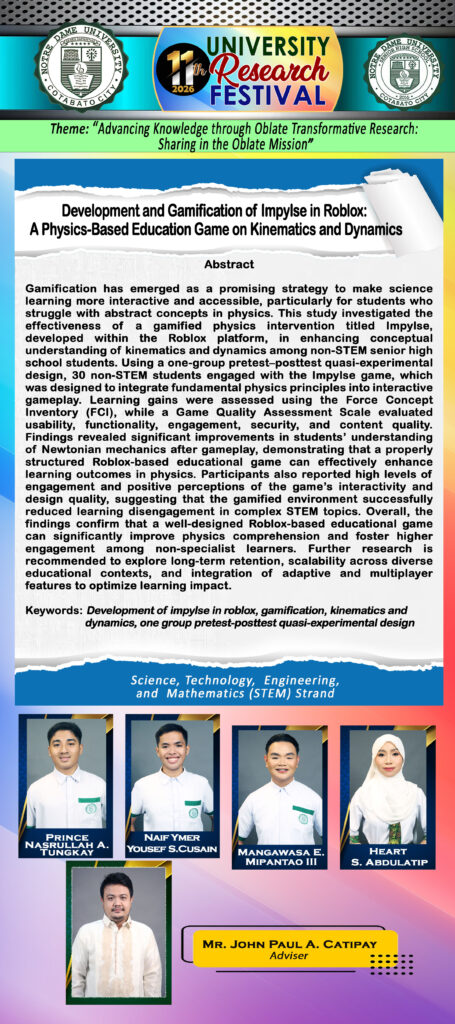
Electricity-related carbon emissions of selected university buildings before and after solar photovoltaic (PV) system installation
Bai Alyzza Zcharinnah T. Mampen, Kamille Antonette G. Del Mundo, Kirsten Leira Cassandra Porras, and Rahima Y. Abdulatip quantified carbon emissions from selected university buildings before and after solar PV installation using a causal-comparative design. Their analysis showed overall reductions in electricity use and emissions, with statistically significant decreases in two buildings, reinforcing the impact of renewable energy on institutional sustainability.
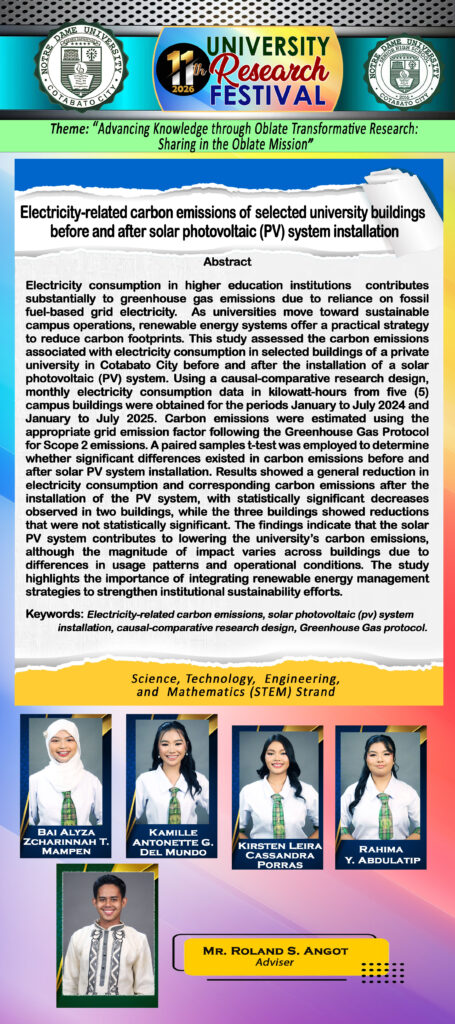
Water quality utilization, attitude, and willingness-to-pay of residents in Dalumangcob, Sultan Kudarat, Maguindanao del Norte, BARMM, Philippines
Precious Fem D. Makilang, Jasmine D. Kiakan, Kamila D. Maliga, and Joevic P. Arsolon investigated water safety and community attitudes in Dalumangcob, Sultan Kudarat. Laboratory tests confirmed fecal coliform contamination in well water, while surveys showed strong support for WaSH programs but limited willingness-to-pay due to low income, pointing to the need for government and organizational support for safe, affordable water systems.
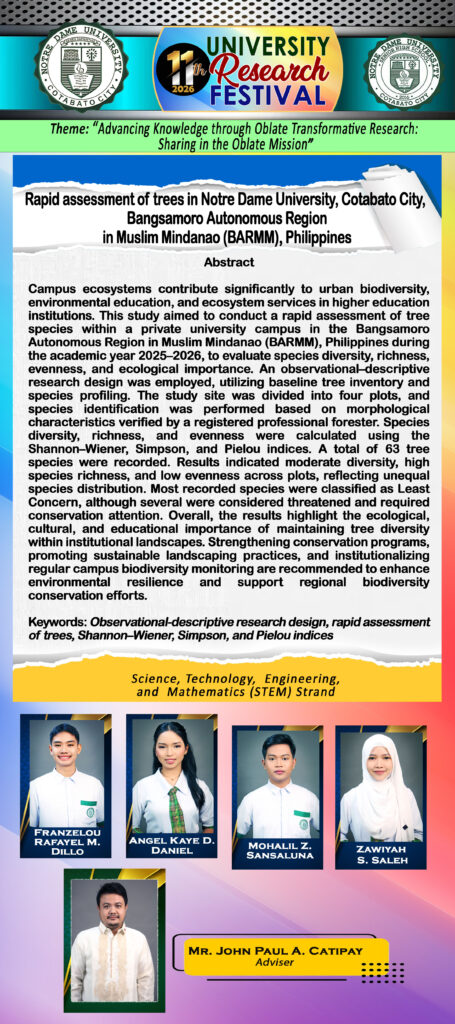
Rapid assessment of trees in Notre Dame University, Cotabato City, Bangsamoro Autonomous Region in Muslim Mindanao (BARMM), Philippines
Franzelou Rafayel M. Dillo, Mohalil Z. Sansaluna, Angel Kaye D. Daniel, and Zawiyah S. Saleh conducted a rapid tree species assessment within the NDU campus, documenting 63 species with moderate diversity, high richness, and low evenness. The presence of threatened species highlighted the campus’ ecological value and the need to strengthen conservation, sustainable landscaping, and regular biodiversity monitoring.
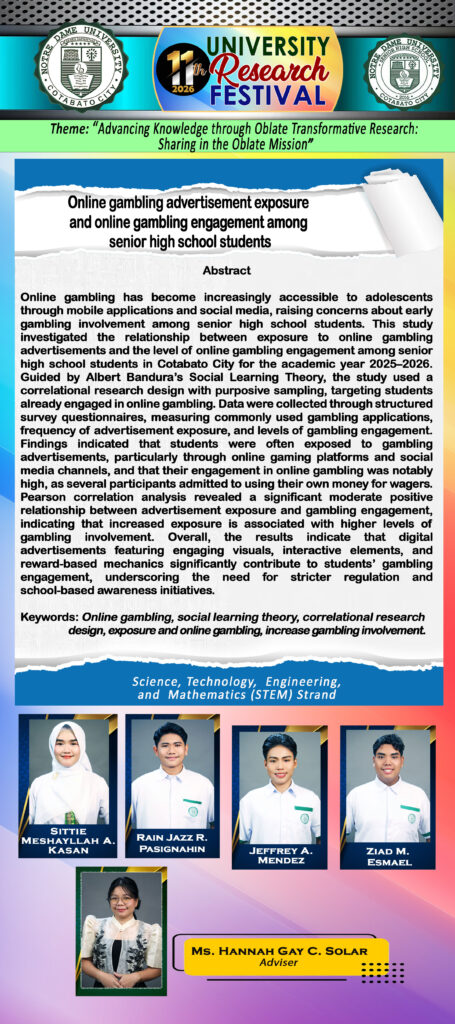
Online gambling advertisement exposure and online gambling engagement among senior high school students
Sittie Meshayllah A. Kasan, Rain Jazz R. Pasignahin, Jeffrey A. Mendez, and Ziad M. Esmael analyzed how exposure to online gambling advertisements is related to gambling engagement among SHS students in Cotabato City. Guided by Social Learning Theory, their correlational study found frequent exposure to gambling ads on gaming platforms and social media and a moderate positive relationship between ad exposure and gambling involvement, calling for tighter ad regulation and school-based awareness initiatives.
Exploring Youth and Society Through HUMSS-Led Research
HUMSS researchers brought forward thought-provoking inquiries into culture, politics, and identity formation.
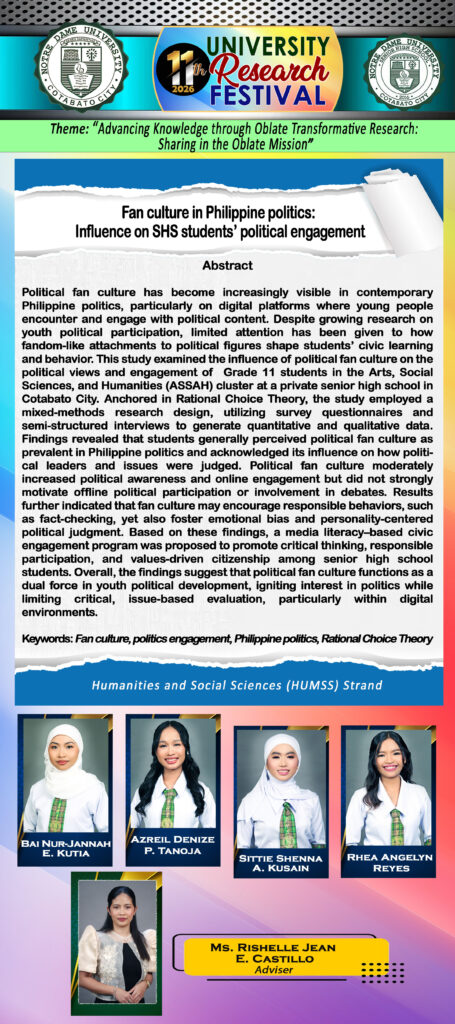
Fan culture in Philippine politics: Influence on SHS students’ political engagement
Bai Nur-Jannah E. Kutia, Azreil Denize P. Tanoja, Sittie Shenna A. Kusain, and Rhea Angelyn Reyes explored how political fan culture influences Grade 11 students’ political awareness and engagement in a private SHS in Cotabato City. Their study showed that fandom-like attachments to political figures can raise online political interest and encourage fact-checking, but may also foster emotional bias and personality-centered judgments rather than issue-based evaluation.
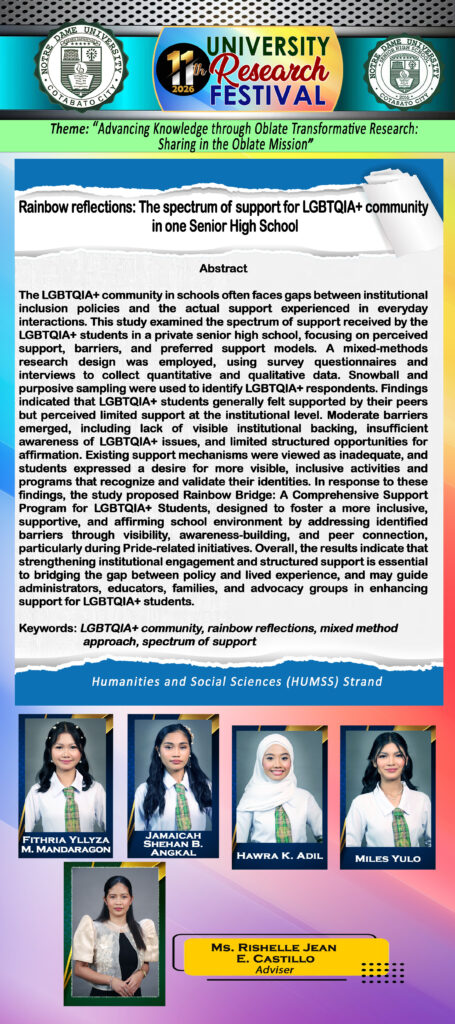
Rainbow reflections: The spectrum of support for LGBTQIA+ community in one senior high school
Fithria Yllyza M. Mandaragon, Jamaicah Shehan B. Angkal, Hawra K. Adil, and Miles Yulo documented the support and barriers experienced by LGBTQIA+ learners in one senior high school. Their findings revealed strong peer support but limited visible institutional backing, leading them to propose “Rainbow Bridge,” a comprehensive support program focused on visibility, awareness, and affirmation.
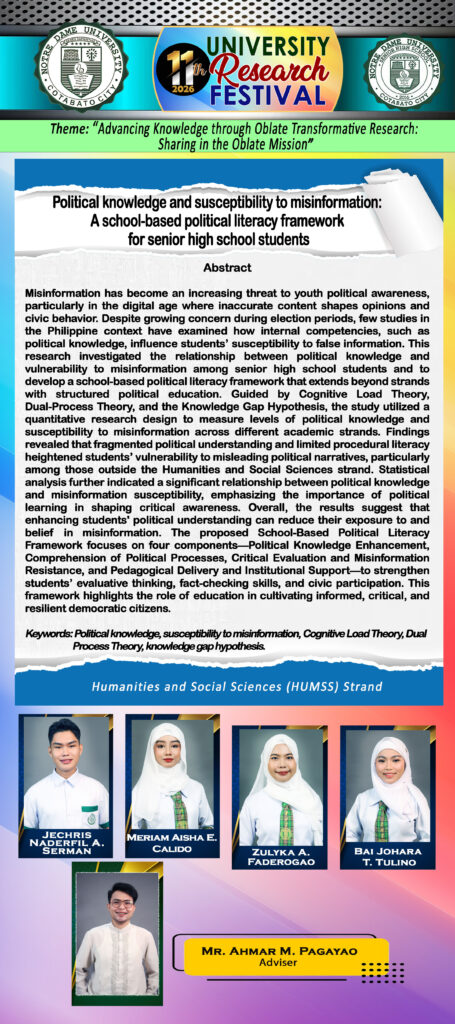
Political knowledge and susceptibility to misinformation
Jechris Naderfil A. Serman, Meriam Aisha E. Calido, Zulyka A. Faderogao, and Bai Johara T. Tulino investigated how levels of political knowledge shape students’ vulnerability to misinformation across strands. Their quantitative study confirmed a significant relationship between political knowledge and susceptibility to misleading narratives and led to a School-Based Political Literacy Framework aimed at strengthening critical evaluation, fact-checking, and civic participation.
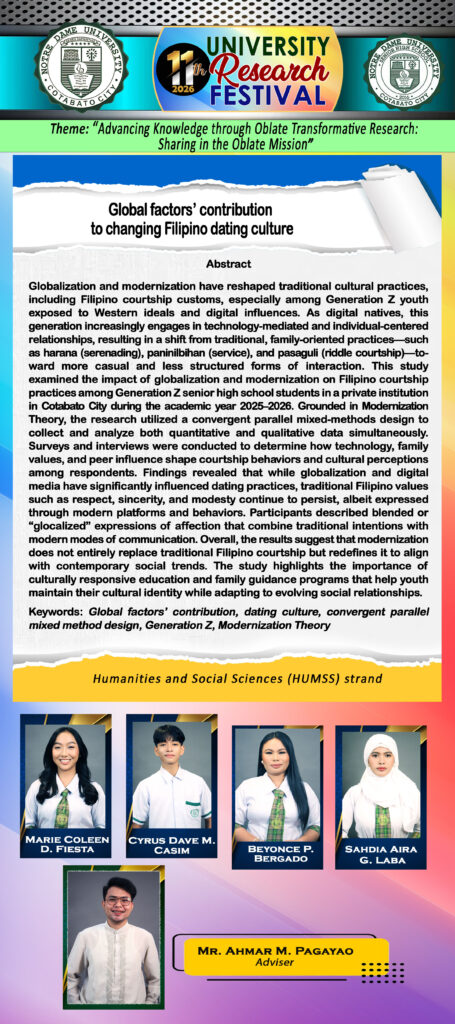
Global factors’ contribution to changing Filipino dating culture
Marie Coleen D. Fiesta, Cyrus Dave M. Casim, Beyonce P. Bergado, and Sahdia Aira G. Laba examined how globalization and digital media reshape Filipino courtship practices among Generation Z. While contemporary dating is now often technology-mediated and less structured, they found that core Filipino values such as respect and sincerity persist, now expressed through blended or “glocalized” practices.
ABM Lens: Business Sustainability and Eco-Entrepreneurship
ABM researchers linked business decisions with sustainability, discipline, and environmental responsibility.
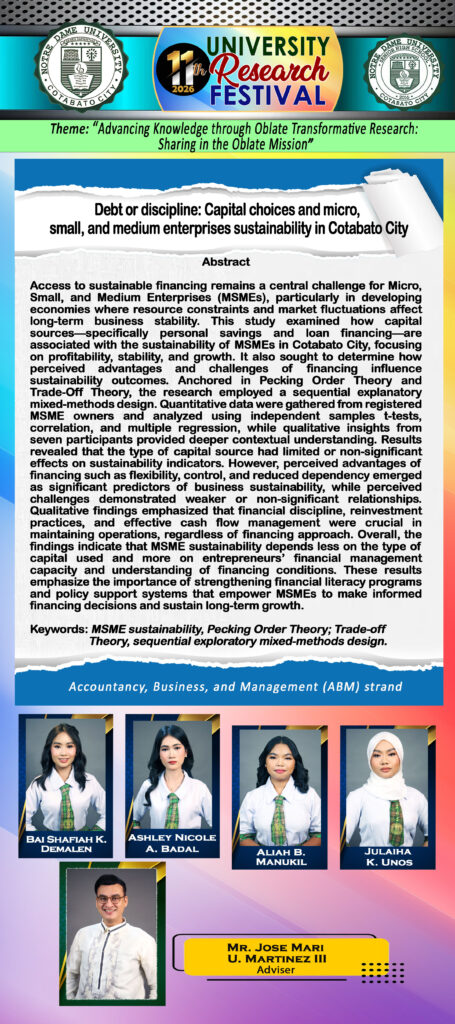
Debt or discipline: Capital choices and micro, small, and medium enterprises sustainability in Cotabato City
Bai Shafiah K. Demalen, Ashley Nicole A. Badal, Aliah B. Manukil, and Julaiha K. Unos compared personal savings and loan financing in relation to MSME sustainability in Cotabato City. Their results showed that the type of capital source has limited direct effect on sustainability; instead, financial discipline, reinvestment, and cash flow management emerged as more critical in ensuring long-term business stability.
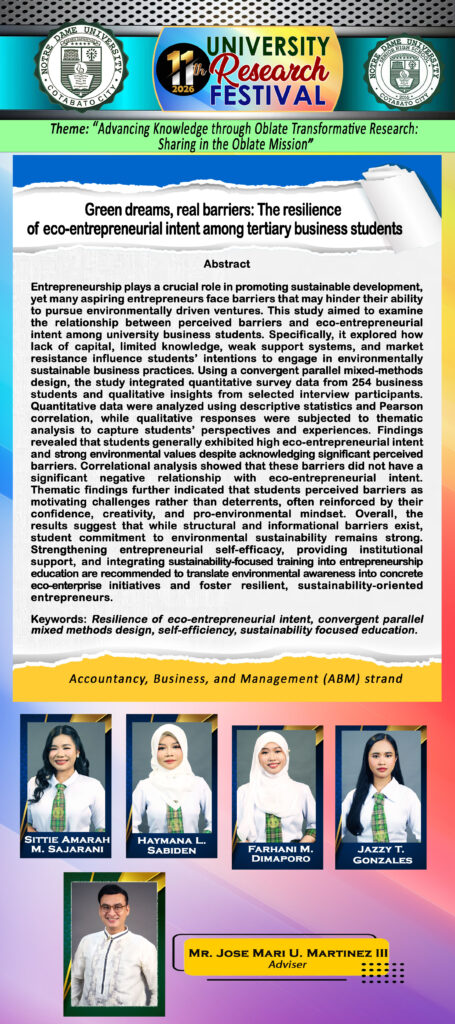
Green dreams, real barriers: The resilience of eco- entrepreneurial intent among tertiary business students
Sitte Amarah M. Sajarani, Haymana L. Sabiden, Farhani M. Dimaporo, and Jazzy T. Gonzales examined how perceived barriers—such as lack of capital and weak support systems—affect eco-entrepreneurial intent among business students. Despite acknowledging significant obstacles, respondents maintained high intent to pursue eco-friendly ventures, viewing barriers as challenges to overcome rather than deterrents, and underscoring the importance of institutional support and sustainability-focused entrepreneurship education.
With 15 diverse and methodologically sound studies, the 11th University Research Festival demonstrated how Senior High School learners can meaningfully engage with real-world problems while rooted in faith, ethics, and community. From combating misinformation and strengthening LGBTQIA+ support, to innovating in health technologies, advancing environmental stewardship, ensuring halal integrity, and nurturing sustainable entrepreneurs, each paper reflected the Oblate vision of education for social transformation.
By empowering SHS students to conduct and present their own research, NDU not only advances knowledge but also forms young researchers who are ready to contribute to peace, justice, and sustainable development in Mindanao and beyond.